


Issue 27
Climate is a winnable narrative war… if we show up.
At the end of last year, we looked back on five years of data to help address some of the most burning questions we are hearing from partners. And it’s not a small data set as we have now tested over one thousand messages. One of the most pressing was: Can we win the public on climate?
What we learned after diving into the data is “absolutely”–with a caveat. Support for the policies we need is actually very strong and in many cases bipartisan. From conservation to clean energy to phasing out fossil fuels, favorability far outweighs opposition, which, while vocal, is narrow and beatable–if we show up consistently with persuasive narratives. That’s the caveat. We can win. But it’s a narrative war, and we need to show up at scale.
Support for the actual policies we need is strikingly high, with much more favorability than opposition. As the table below shows, climate policies are broadly popular, and most have support across political parties. It’s a simple point that bears reinforcement: Americans want to conserve the environment, reduce pollution, expand clean energy, phase out fossil fuels, and incentivize electrification.
The data says.
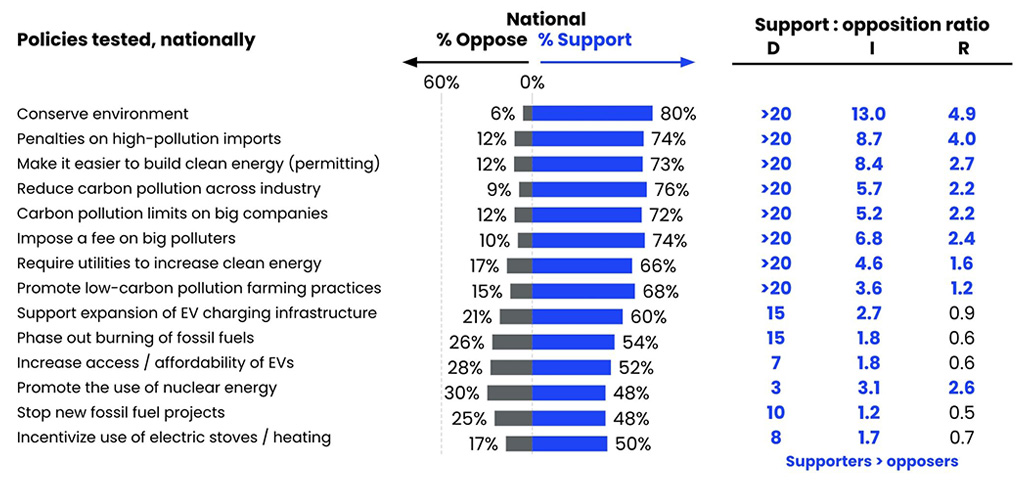
Furthermore, even within those small gray bars of “opposition,” many are open to new ideas. “Committed opponents”–those firm in their opposition and not moved by climate change messages–represent only about 10-15% for each of the potential policies, which means the vast majority are open to action.
In short, the people aren’t nearly as polarized as our politics is.
However, each policy is a narrative war, and many hang in the balance. This is perhaps the most important point: Narratives on either side move audiences a lot. While baseline support is widespread, it’s also unsturdy. Audiences are moved by narratives that promote or oppose key policies. That leaves people vulnerable to anti-clean-energy disinformation, which is becoming more and more widespread.
But there’s good news, too. We’ve created pro-clean-energy narratives that have an even more significant positive impact. And through rigorous testing, we’ve identified the narratives that work best.
Let us explain: in our work, we seek to create support for various policies – on expansion (deploying more clean energy), electrification (enacting transportation standards, industry regulations, and building electrification), and fossil reduction. To do so, we test multiple narratives attempting to engender support for these policies, as well as commonplace and highly effective counternarratives used as ways to slow them down.
One example: at baseline, 52% of Americans support programs that would advance electric vehicles. But if you expose those people to an anti-EV narrative that portrays EVs as “greenwashing” and “unpragmatic,” support plummets to 37%. Now, what happens if they see a pro-EV narrative? If you expose them to the common pro-EV narrative that EVs will create jobs and boost the American auto industry, support does increase – but only to 54%. A far more effective narrative that we created, “Clean Cars for All,” which emphasized expanding choice and accessibility, was able to increase support to 65%, turning what before was a razor-thin majority into rather decisive support for programs that would advance electric vehicles.

We saw similar results across all the policies we tested. Those exposed to opposition narratives did become less supportive. But, to an even greater degree, those exposed to the narratives we developed, which promoted the benefits of the policy in visceral and human terms, dramatically increased their support.
All this to say: we’re in a narrative war. With the right narrative, policy battles are entirely winnable. When we combine forces, we can tip the scales in favor of action. But when people are exposed to the wrong narrative, progress becomes improbable due to the decrease in public support.
Of course, the politics of it all still matters intensely – winning over the public isn’t everything. But our conviction is in the long run, the citizen voice will matter, and in the immediate term there are significant opportunities across states and across countries to win now.
We’re at a critical inflection point with climate change and our progress toward solutions. Much hangs in the balance, and we hope this data can help us bolster support for the climate change progress we so urgently need.
When we show up, we win. But we must show up.
Article by John Marshall and Jessica Lu

John Marshall is the founder and CEO of Potential Energy. John advises global leaders on strategies to effectively communicate about climate solutions, and is a frequent industry commentator and speaker. John’s innovative approach to building public support for climate action is informed by his 30+ years of experience advising the leaders of Fortune 500 companies on branding and marketing.

Jessica Lu is Associate Director of Strategy and Analytics and leads Potential Energy’s Insights Lab. She leads teams that execute hundreds of message tests and focus groups and perform in-market measurement analytics to unearth what motivates humans to care about climate change. Jessica graduated from Princeton University with a degree in Civil and Environmental Engineering.

Related topics

Fixing Climate Communications, a New Global Report
Announcing a new global report on how climate communicators can move beyond narrow narratives and power durable progress.

Finding a Common Language for Carbon Dioxide Removal
We conducted a large-scale public opinion study across the US and UK to learn what people currently think…

Five Simple Shifts for Climate Communication in 2026
Drawing on our recent research, messaging testing and real-world campaigns, we’ve pulled our most consistent insights into a…