


Issue 26
The data is clear – we must, and can, depolarize the climate movement.
After the election, climate leaders are appropriately pondering the strength of the climate movement, the relative priority of climate as an issue, and what the most effective strategies to engage the public should be going forward. With the benefit of a significant amount of data gathered over the last 5 years, Potential Energy will be publishing and briefing groups on these burning questions over the next month.
In the immediate term, we thought it appropriate to surface some key additional insights from our global study which bear on this issue.
As our readers know, our sole guide is “what does the data say.” With that in mind, with our collaborator Simon Glynn, we carried out a large global segmentation, built solely on people’s moral values. At the core of this analysis is the question: does action on climate need to appeal to only a narrow group on the ideological spectrum? Simon’s excellent article The Silent Majority On Climate, is found here in Persuasion, with a deeper analysis here.
The data – both globally and in the US – is clear. Our survey of 58,000 people across the G20 and beyond shows there is a large, untapped base of support on the political Right. Perception of climate change as a left-leaning political agenda is limiting support for climate action across the world.
The analysis shows there is a key base of support we need. Simon calls them “Engaged Families,” a large segment with strong egalitarian morals, but who look for equality more in shared opportunity than in government intervention in the outcome. They are optimistic, confident about the future, and believe that the world will be a better place for their children than it was for them. They are looking for growth and prosperity, and see sustainability as the way to achieve that, not to substitute for it. Interestingly, this segment exists globally and in the U.S. (This is very similar to the moderate segment we target with our Science Moms brand, who we have moved to become strong climate supporters with very good economics.)
What the data says: The vast majority of people globally support “new nuclear,” especially environmentalists.
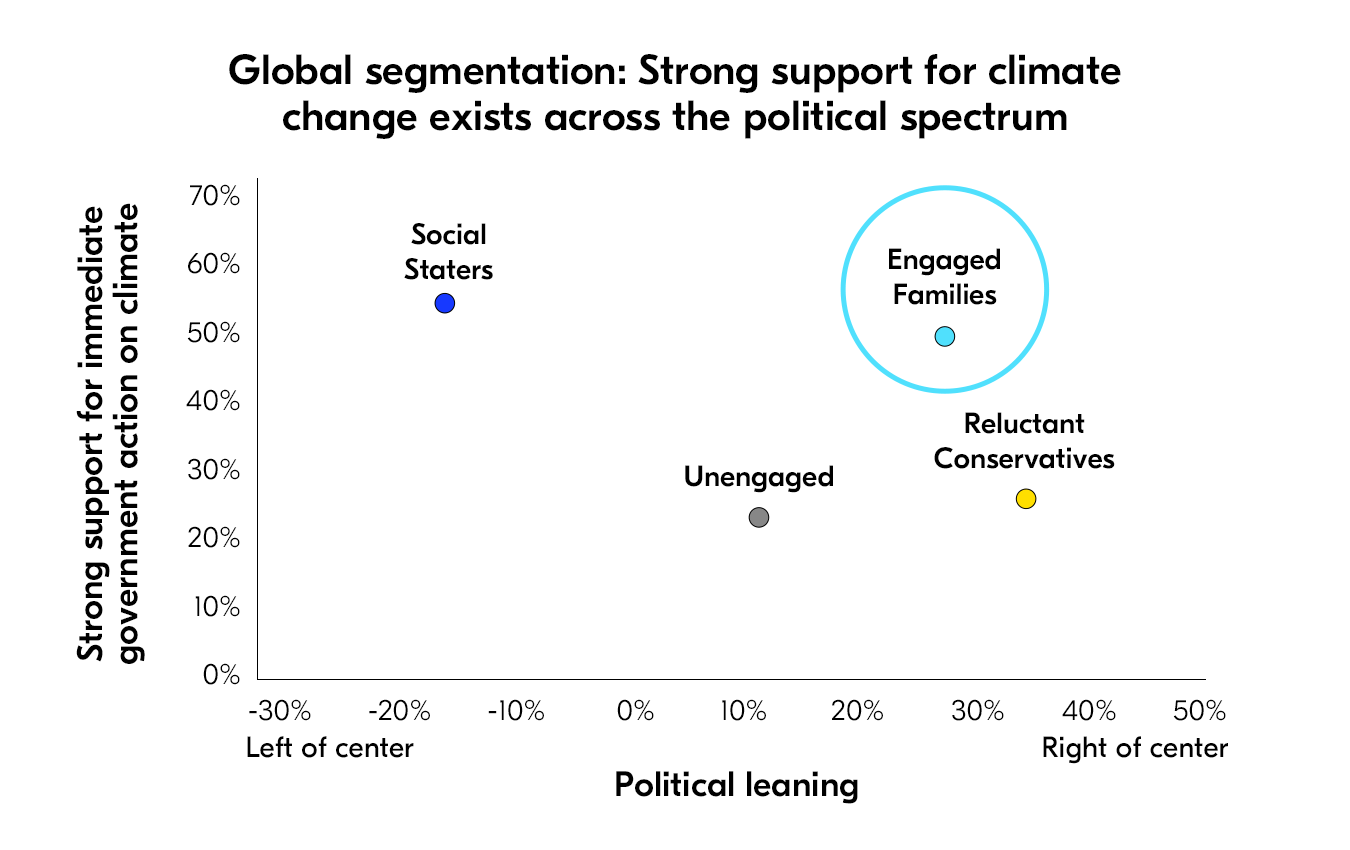
By neglecting this group, we are failing to turn their climate concern and desire for action into support for actual climate policies. It will not be easy, and will require substantial resources. But the stakes are worth it. If we learn to connect with this group, we can extend the support for climate policies from a minority to a majority. But reaching new segments will require new messages and shedding some of our last attachments, with greater focus on materiality and kitchen table issues. It will also require deep listening to new audiences about what is relevant to them, recognizing that many people are concerned about making ends meet on a weekly basis.
This is one of many guideposts we are seeing in our data. We look forward to sharing more in the coming weeks.
Article by John Marshall and Jessica Lu

John Marshall is the founder and CEO of Potential Energy. John advises global leaders on strategies to effectively communicate about climate solutions, and is a frequent industry commentator and speaker. John’s innovative approach to building public support for climate action is informed by his 30+ years of experience advising the leaders of Fortune 500 companies on branding and marketing.

Jessica Lu is Associate Director of Strategy and Analytics and leads Potential Energy’s Insights Lab. She leads teams that execute hundreds of message tests and focus groups and perform in-market measurement analytics to unearth what motivates humans to care about climate change. Jessica graduated from Princeton University with a degree in Civil and Environmental Engineering.

Related topics

Fixing Climate Communications, a New Global Report
Announcing a new global report on how climate communicators can move beyond narrow narratives and power durable progress.

Finding a Common Language for Carbon Dioxide Removal
We conducted a large-scale public opinion study across the US and UK to learn what people currently think…

Five Simple Shifts for Climate Communication in 2026
Drawing on our recent research, messaging testing and real-world campaigns, we’ve pulled our most consistent insights into a…